Statement on US, Israel and Iran
What's Happened?
The United States and Israel launched a large scale coordinated military operation against Iran on February 28, 2026, targeting Iranian leadership, ballistic missile sites, and key military infrastructure. The escalation follows stalled nuclear talks and months of rising tensions between the nations.
Iran's Supreme National Security Council confirmed that their Supreme Leader Ayatollah Ali Khamenei was killed in the initial strikes, along with dozens of senior military officials.
Iran retaliated with missile and drone strikes targeting Israel and US bases across the Middle East, including in Bahrain, Kuwait, Qatar, Saudi Arabia, and the UAE resulting in multiple casualties. Missile strikes also hit Dubai and Abu Dhabi airports - two of the busiest airports globally, leaving one dead and hundreds of thousands of travellers stranded.
What to look out for next
Oil prices have rallied to more than $80 a barrel, a 14-month high, as the war threatens the closure of the Strait of Hormuz. This sea passage ships approximately 20% of global oil. A sustained oil price rally could have a significant inflationary impact in combination with rising shipping insurance premiums. This remains a key focus for investors, as it has the potential to derail the outlook for further interest rate cuts, which has been a key driving force behind the recent uplift in global markets.
Why it's important not to react
Markets are down this morning, but perhaps not as aggressively as you might have thought. Regardless of what happens in markets over the next few days and weeks, it's worth remembering that historically markets rebound after major falls, and often the best days can follow the worst.
What this means for investors
It is understandable that you may have questions or concerns about what is happening to your investment portfolio.
The first step is always to ensure that your investments are aligned with your risk profile, as this helps ensure that the level of volatility remains within the range you would expect. A financial adviser can help with assessing your risk profile. More broadly, we have been mindful of the overvaluation in the United States stock market and have already diversified and reduced outright exposure in client portfolios. Some of this diversification has been into US Energy, and that shift will likely benefit from any surge in oil prices.
The bottom line is that we are continually monitoring the portfolios so that they remain well positioned across a wide range of scenarios. If the situation were to evolve into a major risk-off event, all assets would be affected. However, we would expect our hands-on approach to asset allocation to help limit the impact on portfolios.
Our portfolios are designed with a long-term focus, and history consistently shows that markets recover and move higher after periods of stress.
The chart below compares the growth of £10,000 invested in global equities with leaving money in a cash deposit account over the past 30 years, as well as the impact of inflation.
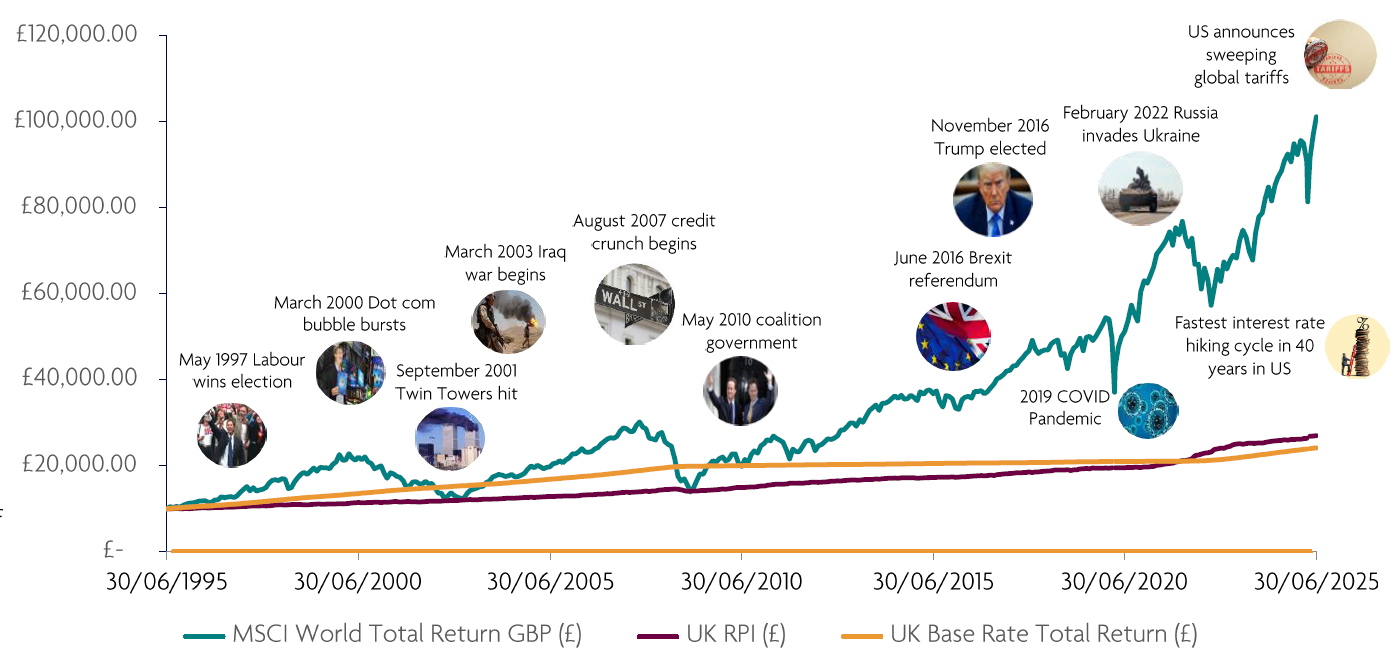
*Source: Bloomberg as of June 2025
