Markets Rebound but Energy Risks Linger
Global markets rallied in April, but the Iran conflict and surging oil prices continue to cloud the outlook.
Markets recover as tensions persist.
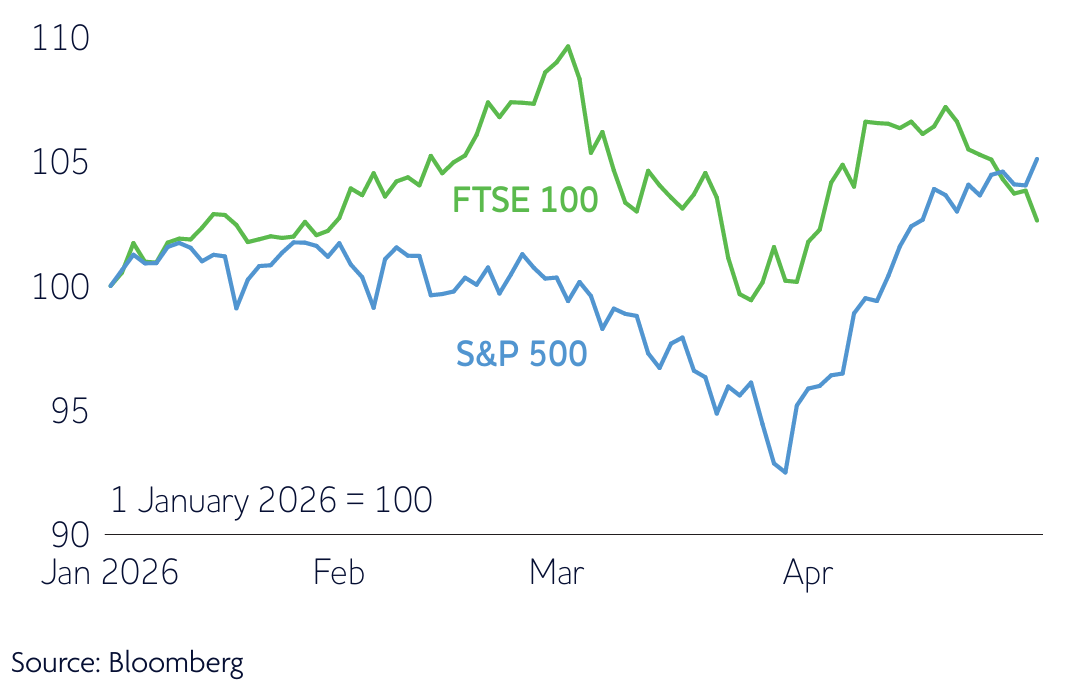
Global markets recovered in April, with stocks rebounding from March’s losses. US equities climbed to fresh highs, supported by strong earnings and AI-driven growth, while the FTSE 100 regained ground. European and Asian markets also moved higher.
Central banks are facing a more complex backdrop as the US–Iran war adds to inflationary pressures and uncertainty around growth. Optimism briefly improved following a two-week ceasefire, but negotiations have since stalled.
Disruption in the Strait of Hormuz has persisted, keeping oil prices volatile. Crude rose above $126 a barrel at one point, the highest since 2022, after President Donald Trump warned the US blockade of Iranian ports could last for months.
Fed keeps rates on hold.
The US Federal Reserve (Fed) held interest rates for a third consecutive meeting as inflation rose and uncertainty increased. US inflation jumped from 2.4% in February to 3.3% in March, driven largely by higher energy prices.
The increase is the largest in nearly two years, echoing the inflation shock seen after the invasion of Ukraine. Consumer sentiment has fallen to a record low as households react to rising costs. Gasoline prices have climbed above $4 a gallon, raising concerns about weaker consumer spending.
Despite this, the labour market remained resilient. Employers added 178,000 jobs in March, while unemployment edged down to 4.3%.
UK inflation rises.
The Bank of England held interest rates at 3.75% in April despite rising price pressures. UK inflation increased to 3.3% in the year to March, up from 3% the previous month, driven largely by higher fuel costs.
Rising prices and economic uncertainty have pushed consumer confidence to a two-year low. The UK’s reliance on imported gas leaves it exposed to energy shocks, with inflation expected to remain elevated over the short to medium term.
The labour market showed mixed signals. Unemployment fell to 4.9%, while regular pay growth slowed to 3.6%, which is its weakest level since late 2020.
China’s growth rebounds.
China’s economy grew 5% year-onyear in the first quarter, showing resilience despite disruption from the Iran conflict. Industrial output rose 5.7% in March and retail sales increased 1.7%.
The economy has so far absorbed the shock, supported by large oil reserves and renewable energy. But growth is expected to slow later in 2026, with inflation beginning to rise as energy costs feed through.
In Europe, the European Central Bank (ECB) kept rates on hold at 2% for a third meeting. Eurozone inflation rose sharply to 2.6% in March from 1.9% in February, driven by higher energy prices. Private sector output weakened, with activity slipping and demand softening. Manufacturing held up better, but falling confidence and rising costs have increased concerns about stagflation.
Figure 1: Stockmarkets recover
US and UK equities made steady gains in April following a dip in March
due largely to the conflict in the Middle East.
Download Omnis Market Update (pdf)
