Markets end the month on a stronger note
Global equities gained momentum towards the end of September as strong AI investment and corporate earnings supported markets
AI rally lifts global markets.
Global equities picked up towards the end of the month, driven by a powerful AI-fuelled technology rally. Chip and semiconductor stocks led gains as investors welcomed continued AI investment and strong demand. Falling oil prices also provided some relief, although crude prices moved higher again towards the end of September as concerns about the Middle East conflict returned.
Central banks are reassessing the outlook for interest rates amid renewed concerns about persistent inflation caused by higher energy prices. Bond yields also rose towards the end of the period. Corporate earnings have remained strong, with companies continuing to benefit from AI-related investment.
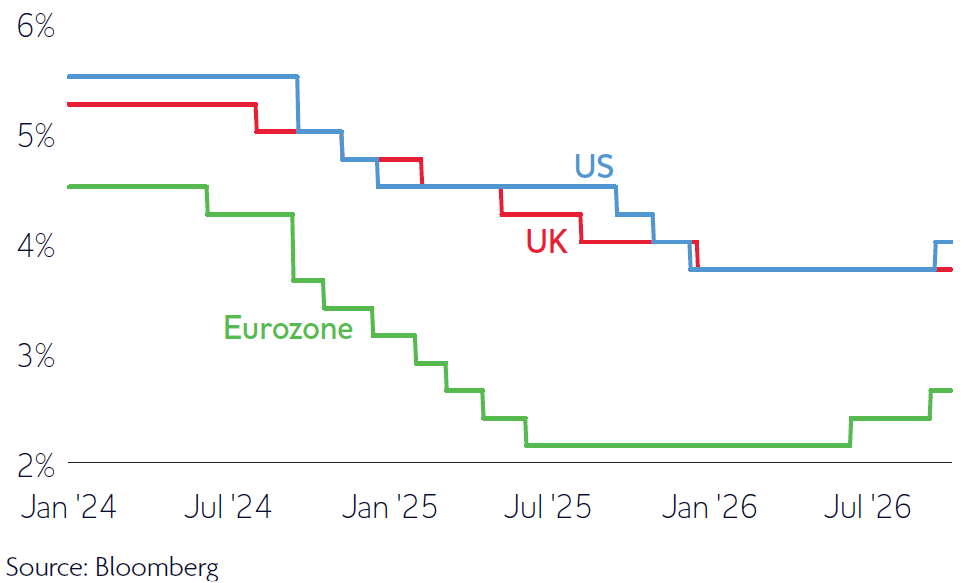
The US Federal Reserve (Fed) raised interest rates by a quarter percentage point to a target range of 3.75% to 4%, its first increase for more than three years. Inflation was unchanged at 3.4%, well above the Fed’s 2% target.
Despite rising price pressures, the US economy remains resilient. Retail sales rose a better-than-expected 1.2% in August, following a revised 0.5% decline in July.
US job growth also picked up sharply, with the economy adding 162,000 jobs in August, more than twice the number economists had expected. The unemployment rate remained at 4.1%.
UK grows faster than expected.
The UK economy grew by 0.5% in the second quarter, which was faster than first estimated, helped by stronger services and business investment. The figures will provide a boost to Chancellor John Healey ahead of his first Budget on 28 October.
The Bank of England held rates steady at 3.75% for the sixth meeting in a row. UK inflation rose to 3.1% in the year to August, while unemployment remained at 4.9%. Average total earnings growth cooled to 3.9%, from 4.2% in the three months to June.
ECB hikes rates.
The European Central Bank (ECB) raised its deposit rate by 0.25 percentage points to 2.5% in September amid rising prices. Higher energy prices pushed headline inflation to 3.3% in August, up from 2.9% the previous month.
The eurozone economy grew by 0.6% in the second quarter, beating the initial 0.4% estimate. Growth was supported by stronger trade and household spending, while annual wage growth eased to 3.3%.
Germany also performed better during the first half of 2026 after several years of weak growth, helped by increased government spending on defence and infrastructure.
China’s exports continued to grow strongly in August, rising 25.0% from a year earlier. Manufacturing also picked up, with output, new orders, and export business all increasing at a faster pace. Meanwhile, industrial output expanded by 5.2%, accelerating from 4.5% growth the previous month.
Figure 1. Interest rates change direction
Central banks have shifted back towards raising rates as inflationary pressures persist
Download Omnis Market Update (.pdf)
