Global stock markets reach new highs
Strong corporate earnings and improving economic signals supported equities in August, despite uncertainty over inflation, interest rates and the Middle East.
Earnings support markets.
Despite heightened tensions in the Middle East, global stock markets remained resilient. US indices hit record highs in August, supported by strong technology earnings and continued optimism around AI. However, gains faded later in the month as comments from the US Federal Reserve (Fed) raised concerns about inflation and interest rates.
European stock markets also reached all-time highs, driven by strong second-quarter earnings and broad gains across sectors. The FTSE 100 maintained its strong July momentum, hovering near record highs. Concerns over Iran's stance on the Strait of Hormuz weighed on markets later in the month. Global bond yields remained elevated, while oil rose above $90 a barrel amid concerns over energy supplies.
US inflation cooled slightly to 3.4% in July, down from 3.5% in June. However, petrol still averaged $4 a gallon, more than $0.85 higher than a year ago. Fed Chair Kevin Warsh suggested that stubbornly high inflation may require further interest rate rises.
US employers cut 23,000 jobs in July, while unemployment held steady at 4.1%. Economists had forecast 80,000 new jobs. Consumer sentiment rose to a five-month high, although renewed Middle East tensions and higher petrol prices could reverse the improvement.
Positive signs for the UK economy.
UK consumer confidence rose to a two-year high in August, with households becoming more confident about making major purchases. Private sector output also grew at its fastest pace for four months, as stronger services activity offset slower manufacturing growth.
UK inflation rose to 2.9% in July as higher energy prices put further pressure on households. This followed a 13% increase in Ofgem's energy price cap, lifting the average annual gas and electricity bill by £221 to £1,862. UK wage growth slowed in June, while job vacancies fell to a five-year low of 707,000 in the three months to July, from 711,000 previously. Unemployment remained unchanged at 4.9% in the three months to June.
Eurozone business activity rebounds.
Eurozone business activity grew slightly faster in August, helped by stronger manufacturing. Germany was a key driver, with manufacturing output rising at its fastest rate since January 2022.
The region's employment rate increased for the first time in 2026, while inflationary pressures continued to ease. The economy grew 0.4% in the second quarter despite continued energy market volatility triggered by the US-Iran war.
China's economy lost momentum in July as industrial output and retail spending slowed, increasing pressure on policymakers to revive growth. Factory output grew 4.5% year-on-year, down from 5.3% in June, while retail sales growth slowed to 0.6% from 1%.
Weak consumer demand and falling investment continue to weigh on sentiment, with second-quarter growth at 4.4%, one of its lowest readings in decades. China has increasingly relied on exports and industrial output as sluggish consumer spending and a deep property downturn weigh on the economy.
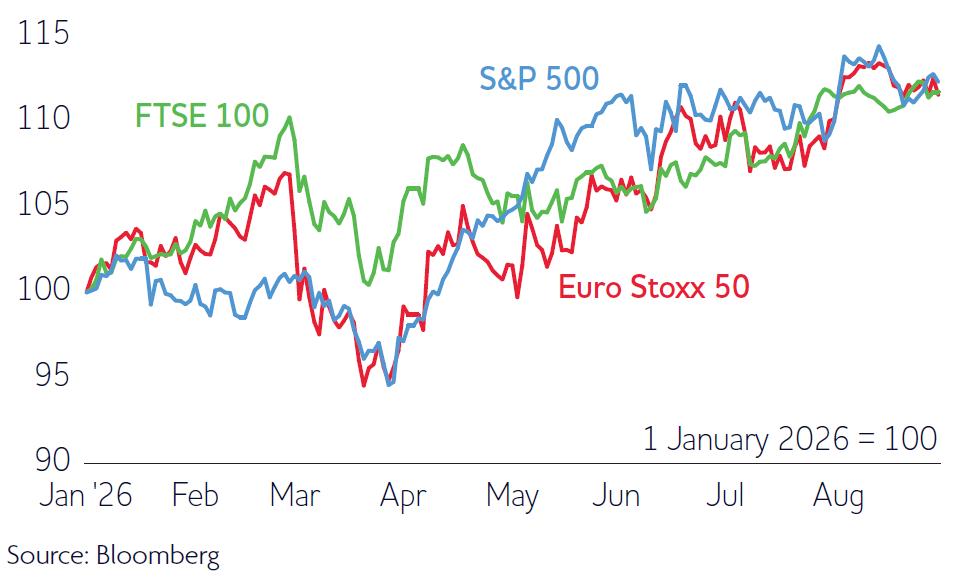
Figure 1. Global equities move higher
Stock markets around the world have continued to make strong gains during 2026, despite periods of heightened uncertainty.
Download Omnis Market Update (.pdf)
