Global markets navigate an uncertain outlook
Corporate earnings, AI investment and economic growth remained in focus alongside inflation, interest rates and geopolitical uncertainty.
Technology shares face pressure.
Global equities experienced mixed performance in October as company earnings and continued investment in artificial intelligence helped offset geopolitical tensions and concerns over borrowing costs. The FTSE 100 reached a seven week high mid-month, while European stocks recorded their strongest monthly gains since June.
US stocks were more mixed as investors rotated away from some of the biggest technology companies. Bond yields also climbed amid concerns over interest rates and increased borrowing to fund AI investment. The US Federal Reserve (Fed) kept interest rates unchanged at 3.75% to 4% in October.
US inflation rose to 3.7% in September, up from 3.4% in August. The jobs market also cooled, with employers adding just 29,000 jobs, down from 133,000 the previous month. Unemployment edged up from 4.1% to 4.2%. US consumer confidence rebounded in October as households became more optimistic about the jobs market.
UK Budget and outlook.
Chancellor John Healey delivered his first Budget, announcing a £100 energy payment for up to 20 million households in England in council tax bands A to D. To help fund the measures, he temporarily raised the tax surcharge on banks to 6% for 15 months and increased tax rates on property and savings income by two percentage points from April 2027.
Britain’s economy grew by 0.1% in August, defying forecasts for a contraction, while annual growth reached 2.1%, its strongest since late 2022. Manufacturing expanded by 1.2%, while computer programming was the biggest contributor over the three months to August, suggesting AI investment is supporting growth. The UK was also the fastest-growing G7 economy in the first half of 2026.
UK inflation rose to 3.5% in September, from 3.1%, increasing the likelihood of a Bank of England rate rise in November. Meanwhile, unemployment fell to 4.7% in the three months to August, from 4.9%, while annual pay growth edged up to 3.7%.
Chinese trade remains buoyant.
China's economy grew by 4.5% in the third quarter, up from 4.3% in the previous three months and ahead of expectations. Exports surged 36.3% year on year in September, driven by strong global demand for technology and pushing the monthly trade surplus to a record high. Beijing is increasing fiscal support to meet its growth target, although weak domestic spending and investment continue to weigh on the economy.
The European Central Bank (ECB) held its deposit rate at 2.5%, despite inflation reaching a three-year high of 3.8% in September. Eurozone business activity expanded at its fastest pace in nearly three-and-a half years, supported by stronger services activity. However, political and economic uncertainty in France weighed on private-sector growth. Policymakers are expected to raise rates again in December, when updated forecasts will provide more clarity on inflation.
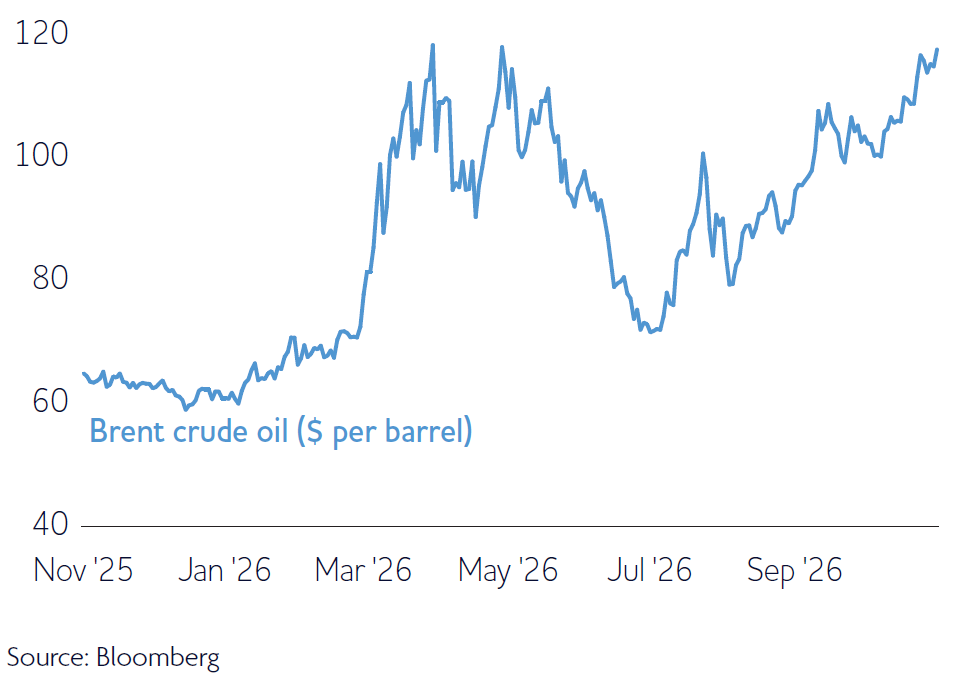
Figure 1: Oil Prices
Brent crude approached $120 a barrel in October as geopolitical tensions and inflationary pressures persisted.
Download Omnis Market Update (.pdf)
