Your Investment Portfolio and The Markets
We explore why your investment portfolio does not always perform in line with popular stock market indices, such as the FTSE 100.
The UK's best-known stock market index, the FTSE 100, is made up of shares from the largest companies listed on the London Stock Exchange. The index includes businesses across different industries, from BP and HSBC to AstraZeneca and Tesco, and these are often referred to as 'blue chip' companies.
However, the FTSE 100 is more concentrated than many investors realise. The 10 largest companies account for nearly half the index. As a result, when we read headlines about how the FTSE 100 is performing, it is often driven more by a handful of large companies than by the broader UK stock market. If you invest in a fund that tracks the FTSE 100, you are heavily reliant on these companies performing strongly.
The FTSE 100 is also concentrated in a small number of sectors. Financials, Consumer Staples, Energy and Materials account for approximately 60% of the index. Financials and Consumer Staples are generally considered lower-growth, more defensive sectors, while Energy and Materials are cyclical sectors whose performance is more closely linked to movements in the wider economy. This concentration means the FTSE 100 can perform very differently from other global markets.
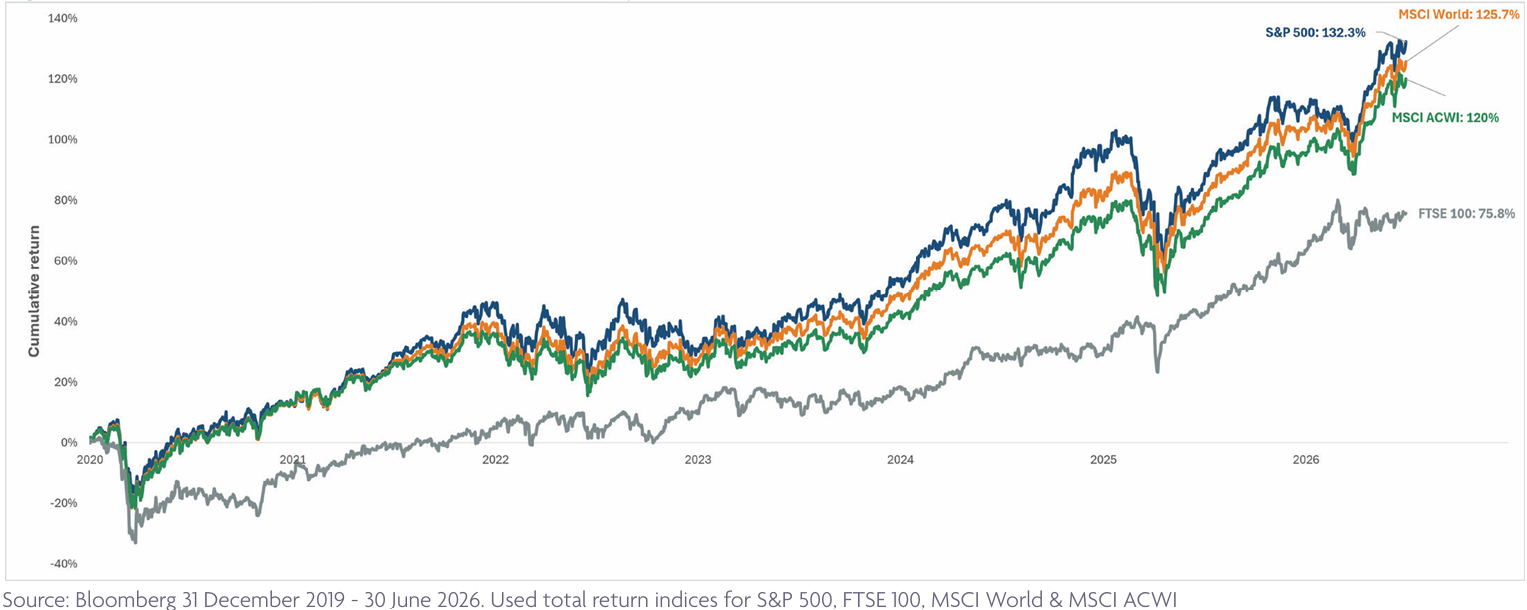
As Figure 1. below shows, the FTSE 100 has lagged both the US and global equity markets since the start of the decade, despite a strong period in 2025 when it outperformed the S&P 500 (in GBP terms) by almost 17.5%. This highlights how differences in regional exposure and market composition can lead to markedly different outcomes for investors.
Figure 1. One market does not tell the whole story.
Why doesn't my portfolio move in line with the FTSE 100?
Your portfolio is designed to help you achieve your financial objectives within set risk parameters, rather than track the performance of a single stock market index.
For example, when you invest in one of the Omnis Agility portfolios, you gain exposure to a diversified mix of equities, bonds and alternative investments across a range of geographical regions and sectors.
In most portfolios, less than a quarter of assets are invested in the UK. For instance, in Omnis Agility IV, our Strategic Asset Allocation allocates 14% to UK equities and 9.25% to UK bonds, with the remaining 76.75% invested across other regions and asset classes.
As a result, when the FTSE 100 rises, the portfolio will not necessarily increase in value by the same amount.
Diversification matters
Omnis portfolios are designed to be well-diversified across asset classes, sectors and regions, while our managers seek to maintain sufficient diversification within each underlying fund.
During periods when a small number of sectors, regions or companies dominate market returns, diversified portfolios can underperform headline equity indices. However, diversification aims to reduce reliance on any single driver of returns and provide a smoother investment journey over time.
Furthermore, our UK equity funds seek opportunities in businesses of all sizes, rather than focusing solely on the largest companies in the FTSE 100. This means that even our UK funds can perform differently from the index.
Investing for the long term
It’s important not to focus too heavily on short-term performance. As Figure 2 below shows, we rarely see one market or region outperform or underperform consistently. The best-performing markets in one year often experience a slowdown in the years that follow, while previously weaker markets can rebound.
Figure 2. Patchwork Quilt – Comparing performance across different markets.
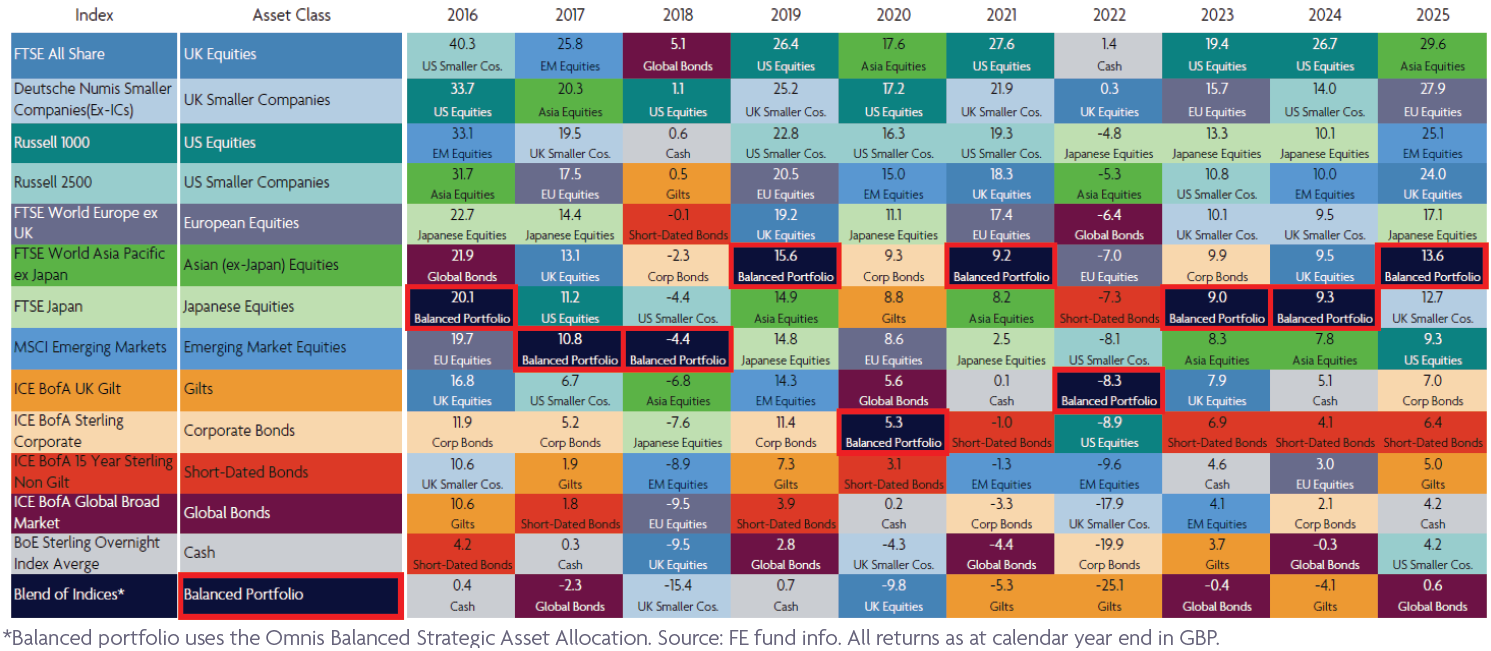
If you look at the returns of a balanced portfolio allocation, these tend to occupy the middle ground between higher returning equity markets and lower risk bond markets. This is what Omnis aims to deliver for clients: a smoother path of returns while managing risk and seeking to capture additional upside through active manager outperformance and tactical asset allocation.
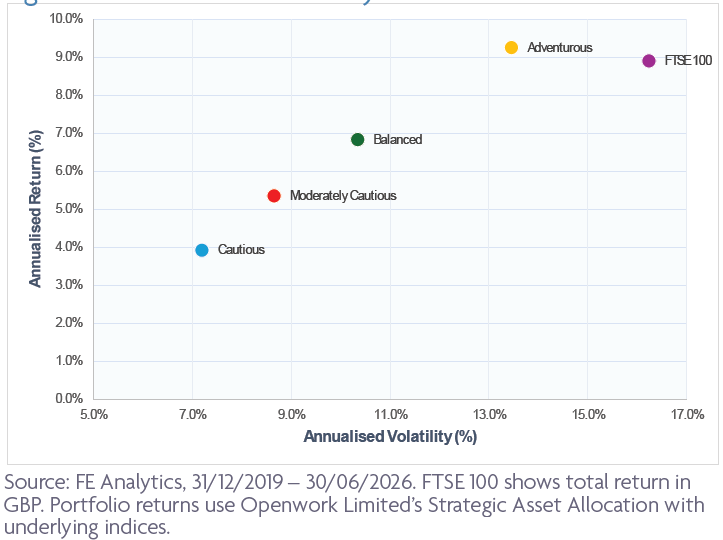
Perhaps more importantly, over five years an adventurous portfolio has delivered superior returns to the FTSE 100, but with significantly lower volatility (Figure 3). In other words, investors have achieved similar outcomes while being exposed to less uncertainty along the way.
Figure 3. Returns and volatility.
While equity markets can be expected to deliver growth over the long term, a geographically diversified multi-asset portfolio can help manage risk in line with your financial objectives.
An active and diversified approach
The advantage of investing in a diversified portfolio is that it can deliver smoother investment performance over the long term. When one part of the portfolio is struggling, another part can help o set the impact. History shows that exposure to different asset classes, industry sectors and global regions is one of the most effective ways to build wealth steadily while managing risk.
Rather than seeking to mirror the performance of a single index, Omnis Agility portfolios are constructed to help investors achieve their goals through a disciplined, diversified and actively managed investment approach.
Download this Investment Perspective (pdf)
Approved by Omnis Investments on 12/08/2026.
Issued by Omnis Investments Limited. This update reflects the views of Omnis at the time of writing and is subject to change. The document is for informational purposes only and is not investment advice. Omnis is unable to provide investment advice. Every effort is made to ensure the accuracy of the information but no assurance or warranties are given. Past performance should not be considered as a guide to future performance. The value of investments and any income from them may go down as well as up and cannot be guaranteed. Prospective investors are reminded to read the fund's Key Investor Information Document and Prospectus prior to investment. These are available free of charge from Omnis Investments Limited. Omnis Investments Limited is authorised and regulated by the Financial Conduct Authority.