A Decade of Political Change
Political changes can often create uncertainty and generate significant market attention, but their long-term impact on investment outcomes is not always straightforward.
Following the recent change in UK leadership, we spoke with three of our investment managers, Schroders, Fidelity, and Franklin Templeton, to gather their views on the potential implications for UK equities, fixed income markets and the broader economic outlook. Their insights help distinguish short-term market reactions from the underlying economic and corporate factors that ultimately drive investment performance over the longer term.
Over the last decade, the UK has experienced an extraordinary period of political turnover. From the Brexit referendum in 2016 to the present day, the UK has had seven Prime Ministers. Those leadership changes have brought changing fiscal priorities and shifts in economic narratives, which have naturally led UK-focused investors to become accustomed to political headlines dominating the news cycle.
As Johnathan Winton, Portfolio Manager at Fidelity recently noted, investors have been navigating heightened political volatility for almost a decade. “While political uncertainty can create periods of short-term volatility, history suggests that investors should be cautious about drawing a direct line between political events and long-term investment outcomes”. Equity markets ultimately reward earnings growth, cash generation and attractive valuations rather than political headlines.
Winton, is of the view point that successful investing comes from “focusing on company specific fundamentals” and identifying businesses where the market may be underestimating future change, rather than attempting to predict political outcomes.
What the evidence says
If we examine UK Equity Markets, UK elections have generally been followed by positive equity market performance, particularly when they deliver an orderly transition of power. Since 2010, UK equities have delivered an average return of 4.7% over the period beginning one month before a new Prime Minister took office and ending 250 trading days later, as shown in the chart below. However, the evidence suggests that market performance is driven less by the individual occupying Downing Street and more by the broader economic and political backdrop:
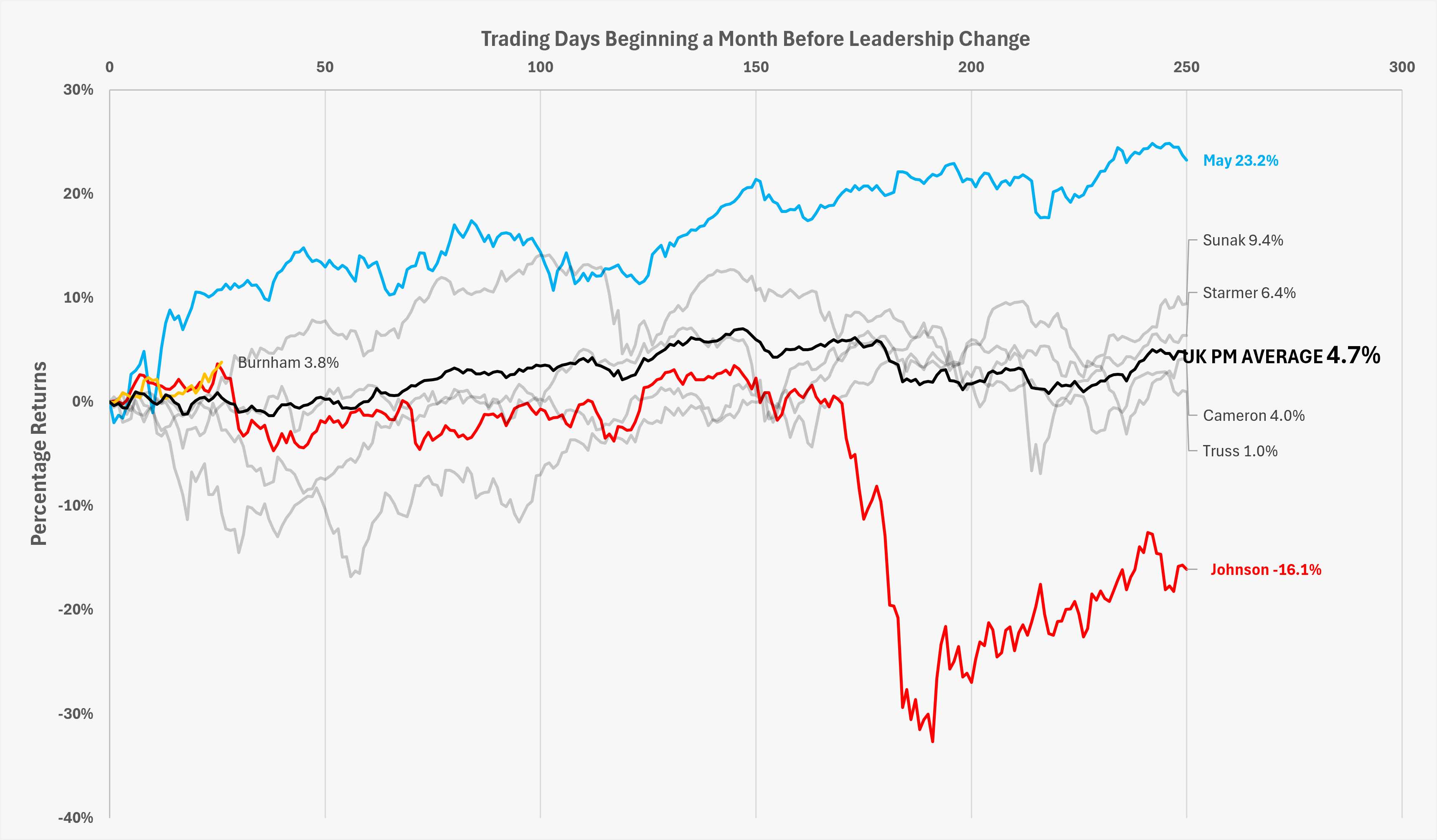
Source: Bloomberg. Investment performance measured from one month prior to each UK Prime Minister taking office and over the subsequent 250 trading days.
While headline figures may appear to favour one party over another, much of the variation can be explained by global events such as the COVID 19 pandemic and inflation shocks, rather than domestic politics alone. Once again, the evidence suggests that inflation, interest rates, economic growth and corporate earnings matter considerably more than the political colour of Westminster.
The latest leadership transition
The transition from Keir Starmer to Andy Burnham has naturally captured investors' attention, and we imagine markets will now focus on fiscal discipline, spending commitments and the credibility of economic leadership. Ben Russon, Co- Head, UK Equites at Franklin Templeton believes that while a change in leadership may bring fresh momentum and a different political style, any incoming Prime Minister remains “constrained by the same fiscal discipline and market pressures as the departing Keir Starmer” which is somewhat needed to maintain market confidence.
In financial services, you often hear the phrase, "past performance is no guide to future returns". If there is one lesson from Liz Truss's 49 days in office and the market reaction to her mini budget, it is how quickly bond markets can respond when fiscal sustainability is questioned. As Ben Russon notes, fiscal credibility remains one of the key factors investors will monitor during any leadership transition. The lesson from that episode is not that investors should fear political change. Rather, it is that all governments ultimately operate within market-imposed constraints. Elevated public debt, higher borrowing costs and the need to maintain investor confidence significantly narrow the scope for policy surprises.
Why UK equities are not the UK economy
An important distinction for advisers is that the UK equity market is not the UK economy. Many FTSE listed businesses generate a significant proportion of their revenues overseas. Global growth, commodity prices, exchange rates, sector specific developments and even trends such as artificial intelligence have a greater impact on returns than domestic policy decisions. This helps explain why UK equities have continued to perform despite concerns around taxation, rising business costs and political uncertainty. Investors should therefore avoid assuming that UK political developments alone drive UK stock market outcomes.
That being said, politics tends to matter most within government bond markets, as changes in fiscal expectations can move gilt yields, which in turn influence borrowing costs, mortgage rates, business investment and consumer sentiment. Schroders has observed that political developments tend to be reflected most directly in bond markets, making fiscal policy and government borrowing plans particularly important considerations for investors. For this reason, investors should monitor developments around government spending plans, taxation and Chancellor appointments. However, professionally managed portfolios are specifically designed to navigate these periods. Active management, tactical asset allocation and global diversification can provide flexibility when markets become unsettled, a point emphasised by Schroders within its multi-asset investment approach.
Time in the market, not timing the market
The greatest risk during political events is often behavioural rather than economic. Elections, leadership contests and shifting policy proposals generate significant media attention and can tempt investors to make emotional decisions. However, successful market timing requires two correct decisions: when to sell and when to buy back in. Very few investors achieve this consistently. History repeatedly shows that some of the strongest periods of market performance have emerged during times of uncertainty. Investors who waited for perfect clarity often missed meaningful recoveries and long-term compounding opportunities.
For many investors, periods of political transition, such as Andy Burnham becoming Prime Minister, can provide an opportunity to reinforce investment discipline. The historical evidence is clear: there is little consistent relationship between the governing party, the size of its parliamentary majority, or changes in political leadership and long-term stock market returns. What matters most are valuations, earnings growth, economic fundamentals and investor behaviour. While volatility should be expected as part of the investment journey, it should not dictate strategy.
Remaining invested through uncertainty, maintaining diversification and focusing on long-term objectives has consistently proven more effective than attempting to position portfolios around political developments.
To conclude
Political headlines will continue to dominate the news flow, and leadership changes will inevitably generate market commentary. Yet the experience of the past decade demonstrates the resilience of both businesses and financial markets. Regardless of who has occupied Downing Street, UK equities have continued to deliver returns for patient investors. The role of financial advisers is not to predict election outcomes or prime ministerial successions, but to help their clients remain focused on their financial goals. In an environment of ongoing political change, the most valuable message remains unchanged: successful investing is driven by time in the market rather than timing the market.
Approved by Omnis Investments on 30 July 2026.
Issued by Omnis Investments, which is authorised and regulated by the Financial Conduct Authority. Registered address: Auckland House, Lydiard Fields, Swindon SN5 8UB. This update reflects our view at the time of writing and is subject to change. The document is for informational purposes only and is not investment advice. Omnis Investments is unable to provide investment advice. Every effort is made to ensure the accuracy of the information, but no assurance or warranties are given. Past performance should not be considered as a guide to future performance. The value of investments and any income from them may go down as well as up and cannot be guaranteed. Prospective investors are reminded to read the fund's Key Investor Information Document and Prospectus prior to investment. These are available free of charge from Omnis Investments Limited.