Navigating the AI investment boom
The AI revolution has captured investors' attention and driven markets higher. But history shows that excitement around new technologies can also push valuations beyond what fundamentals justify.
What are we seeing in markets?
It's hard to think about markets in 2026 without mentioning Artificial Intelligence (AI). Almost every conversation with investors eventually turns to AI, whether it’s the technology's potential to transform industries or the extraordinary market returns it has helped drive.
The excitement is understandable, but it can also lead investors to become overly focused on a single theme.
Today, many of the companies at the centre of the AI story are trading at valuations that assume years of continued growth and profitability. While that optimism may ultimately prove justified, it means investors are paying increasingly high prices today for profits that may not be realised for many years.
Furthermore, many large technology companies have moved from funding spending through cash flow to raising debt and other forms of external financing. A higher-for-longer interest rate environment increases the risk that valuations come under pressure.
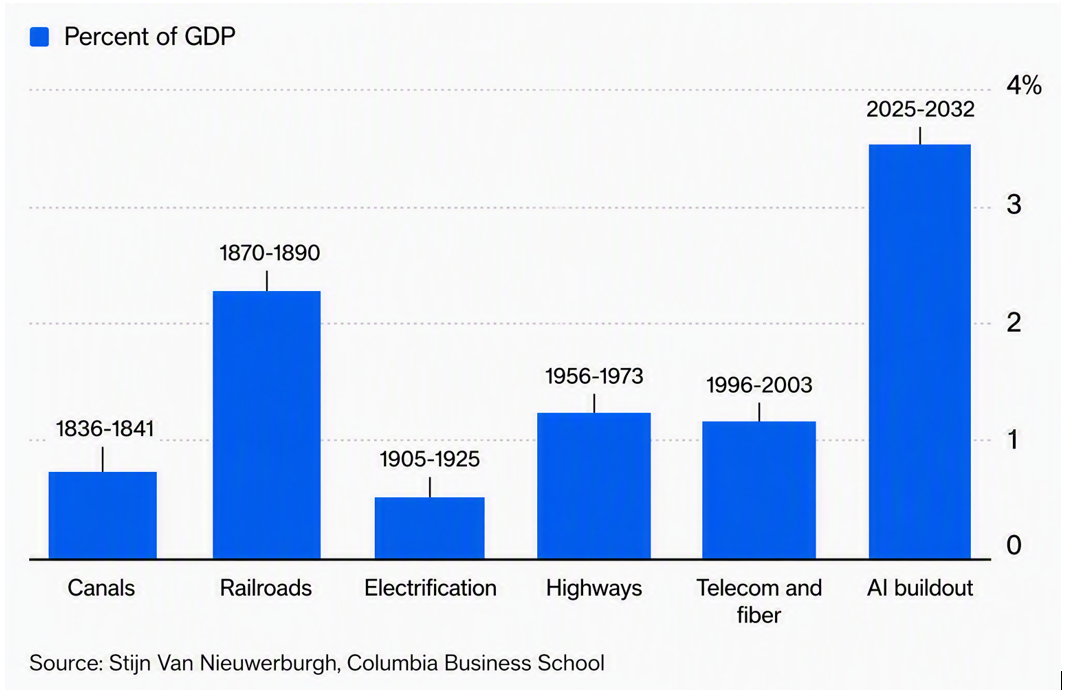
The railway boom and the internet infrastructure buildout provide useful historical parallels. Both transformed economies and society, but many early investors suffered losses as capital investment ran ahead of demand.
As portfolio managers, our role is to look beyond the enthusiasm, assess the risks as well as the opportunities, and ensure our portfolios remain positioned for a range of possible outcomes.
The scale of AI buildout is unprecedented
The chart below compares the size of major technology investment booms throughout history, measured as a percentage of GDP.
How our portfolios are positioned today
- Caution on US equity valuations.
While we see long-term potential in AI, current equity prices in some areas already assume many years of strong growth, leaving less room for disappointment if expectations are not met. - We favour Energy and Healthcare.
Healthcare benefits from long-term structural trends, including ageing populations and rising demand for healthcare services. Energy companies may benefit from ongoing supply constraints and geopolitical uncertainty, and many continue to trade on more attractive valuations than parts of the technology sector. - In Latin America, we maintain a moderate overweight to equities.
Valuations remain attractive relative to many developed markets, while improving economic fundamentals and supportive monetary policy provide a favourable backdrop for investment returns. - We retain a positive view on the Japanese Yen.
We believe the Yen remains significantly undervalued following a prolonged period of weakness. As the gap between Japanese and overseas interest rates narrows and domestic inflation trends normalise, we see scope for further currency appreciation over time. - We continue to see long-term opportunities in both India and China.
India benefits from strong economic growth, favourable demographics and rising domestic consumption, while China offers attractive valuations and the potential for improving investor sentiment as economic conditions stabilise. - In our bond investments, we are taking a more cautious approach.
Higher government borrowing and elevated interest rates can create uncertainty for bond markets. We have therefore reduced exposure to bonds that tend to be most affected by interest rate movements, while maintaining inflation-linked bonds to help protect against the risk that inflation remains stubbornly high.
Omnis Agility Positioning
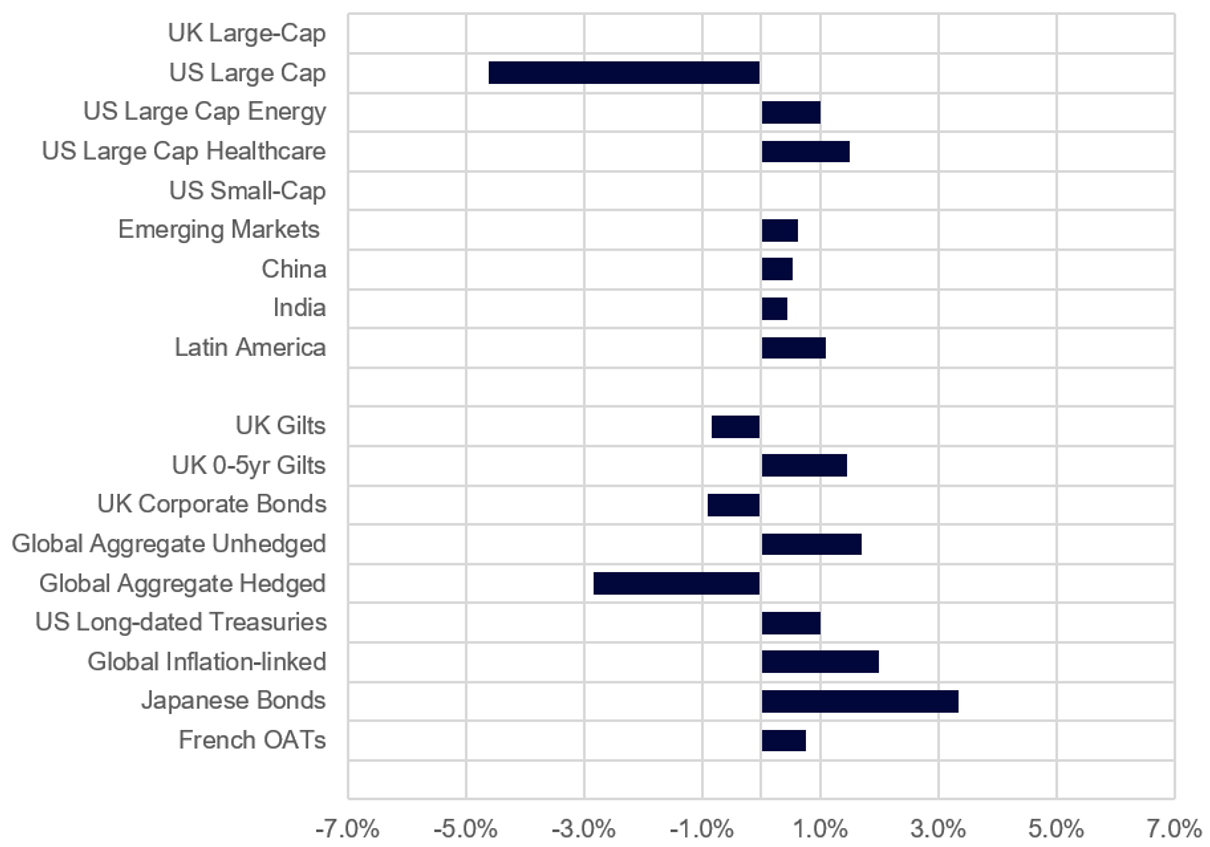
The chart below highlights where we have increased or reduced investments in our Agility range relative to our long-term view.
What's worked well in 2026?
Several portfolio decisions contributed positively to performance this year. Our preference for Energy and Healthcare was rewarded as both sectors delivered strong returns, supported by attractive valuations, resilient earnings and diversification benefits. Allocations to Latin America and China also added value, benefiting from attractive valuations and improving economic conditions.
We also benefited from our positive view on the Japanese Yen, which gained support as interest rate differentials narrowed, inflation rose and policymakers became more supportive of a stronger currency.
In addition, our allocation to US smaller companies performed well as valuations proved attractive and economic conditions improved. We exited the position earlier this year after achieving our investment objective and identifying stronger opportunities elsewhere.
Where have we faced challenges?
Because we have positioned portfolios to reduce exposure to the risk of excessively stretched valuations, we have not fully captured the strong gains delivered by the largest US technology companies this year.
However, we remain concerned that valuations in some areas of the market have become detached from underlying fundamentals.
Summary
The AI revolution has the potential to create significant long-term opportunities for investors, and we continue to maintain exposure to capture those opportunities.
At the same time, we believe that maintaining discipline around valuations, diversification and risk management is increasingly important as investor optimism around AI continues to build.
This is where active portfolio management matters. Our investment experts continually assess emerging risks and opportunities, making adjustments where necessary to help protect portfolios from potential market shocks while ensuring clients remain invested in long-term growth opportunities.
By maintaining a diversified mix of investments across asset classes, regions and sectors, we aim to provide resilience when markets become unsettled, while continuing to participate in the opportunities that drive long-term returns. This allows clients to stay focused on their financial goals, confident that their portfolios are being actively monitored and managed through changing market conditions.
Image Notice: the header banner was created using a combination of Microsoft Copilot, Adobe Firefly, and human experts in The Openwork Creative Team.